Yuri Zhivago and Tonia relationship
Doctor ZhivagoYurii Zhivago and Tonia’s relationship is a marriage of enduring affection tested by war, distance, and Yurii’s growing intimacy with Larisa Antipova. Its defining movement is from the maternity ward, where Yurii learns that Tonia and their newborn son are safe, to an anxious exchange of letters and finally a reunion in Moscow. Their bond is expressed not only in declarations of love but in a shared domestic imagination: they plan how to preserve family life through shortages, even as history presses in around them.
Marriage and the birth of their son
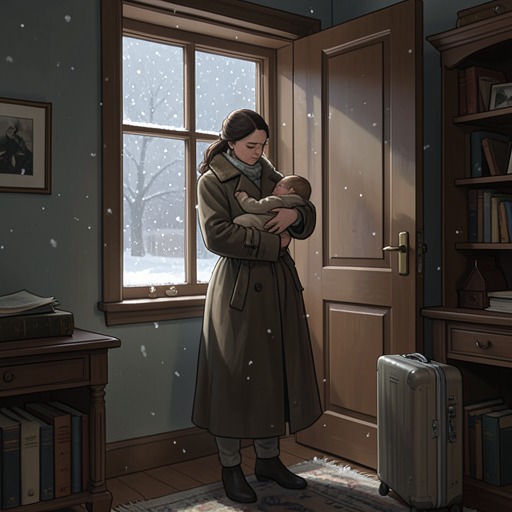
During the second autumn of the war, Yurii, increasingly addressed by his full name, waits outside the maternity ward after bringing Tonia there to give birth. He has patients to visit and work to return to, but remains in the corridor, trying to arrange how the midwife can reach him and watching rain streak across the hospital window. The scene places his professional obligations beside an immediate private fear: Tonia is in labor, and he cannot control what happens inside the ward.
When a nurse emerges and announces the birth of a boy, Yurii first hears that Tonia is safe. His joy is sharpened by relief for his wife, whom he understands to have been in mortal danger. He is almost bewildered by the nurse’s congratulations, unable to claim the birth as an achievement of his own; fatherhood feels like an unexpected gift rather than a triumph he has earned. That hesitation does not diminish his happiness, but establishes the relationship’s emotional emphasis: Tonia’s survival matters to him more urgently than the public role of proud father.
Separation, letters, and divided responsibility
Later, separated from Tonia and their son Sasha by the dislocations of war, Yurii hears from Moscow that Misha Gordon and Innokentii Dudorov have published his book without his permission. It has nevertheless been praised as showing literary promise. The news reaches him alongside reports of mounting public discontent and imminent political events. In a troubled night, he dreams that the wind gives voice to his longing for Tonia, Sasha, home, and work. The imagined speech makes separation palpable as a bodily and emotional disturbance, not simply a matter of distance or correspondence.
In a letter to Tonia, Yurii reports the Russian Army’s disintegration and his own work touring nearby units. He explains that he works with Antipova, a nurse from Moscow born in the Urals, and that he, she, and Galiullin have decided to leave separately after resigning or being discharged. He expects he may arrive unexpectedly, though he will try to send a telegram. The practical account of departure carries an intimate complication: Yurii’s connection with Antipova is close enough to shape what Tonia fears, even though he says he does not know which room she occupies in the house they share.
Tonia’s reply arrives before he leaves. Written in broken sentences marked by sobs, tears, and ink spots, it asks him not to return to Moscow but to go directly to the Urals with the nurse. Tonia imagines Antipova’s life as marked by extraordinary portents and coincidences, against which her own modest life cannot compete. Her letter acknowledges the emotional gulf created by the war and Yurii’s absence, but it also turns toward Sasha’s future: she promises to raise him according to the principles Yurii knew in her family home. Even in pain, she defines her claim through care for their child and continuity of their shared values.
Yurii answers at once, rejecting the idea that Tonia should doubt his attachment. He tells her that faithful thoughts of her and their home helped him endure two devastating years of war, and imagines that they will soon be together and their life will begin again. Yet his reply also contains a more unsettled admission: if his conduct gave Tonia cause to write as she did, it must have been ambiguous, and he has wronged both her and the other woman he is misleading. He intends to apologize to Antipova when she returns from the country, where she has gone to assist a friend working as an instructor amid changes in village government. His reassurance therefore does not erase the conflict; it names his responsibility within it.
Reunion and the work of home
When Yurii returns to Moscow, he approaches the house breathless, his heart pounding, and rings repeatedly before realizing that Tonia has opened the door. The unexpected sight leaves them both momentarily speechless; then the open doorway itself becomes a welcome, and they rush into each other’s arms, speaking over one another. Their first concern is whether everyone is well. Tonia dismisses her earlier letter as foolishness and turns immediately to the practical facts of his arrival, including his belongings and the people who are away. The embrace and the quick household questions together restore the texture of married life.
The reunion takes place amid rumors of famine, cold, and the possible loss of firewood, water, and light. Yurii says that, watching from the train, he wondered what could matter more than peaceful family life and work. He accepts that the coming hardship is beyond their control and argues that an adult should share his country’s fate, while wishing Tonia could be sent somewhere safe, perhaps Finland. His impulse is protective, but it coexists with his refusal to separate private safety from the fate of the country.
Tonia answers approaching scarcity with a plan for the house. She proposes setting aside two or three communicating rooms on the top floor for Yurii, Sasha, herself, his father, and Niusha, partitioning them from the rest of the building and making a self-contained apartment. An iron stove in the middle room, with its pipe through the window, would serve for cooking, laundry, and entertaining, conserving fuel through the winter. The plan is not an escape from history but an attempt to make a workable household inside it. The small domestic arrangements—rooms, a partition, a stove, a shared table—give form to the family life Yurii identifies as precious.
The marriage’s warmth is also stated plainly. After a gathering marked by argument and the sudden clearing of a dusty, smoke-filled room, Yurii tells Tonia that she and his father are the only people he loves in the world, then suggests they go to bed. The statement gives the reunion an intimate close, but the surrounding narrative notes that winter is near and that a human world suspended between one condition and another is approaching. Their home can gather those they love; it cannot stop the political and material crisis outside it.
The relationship’s limits and meaning
Tonia and Yurii’s marriage is shaped by a contrast between emotional constancy and compromised conduct. Yurii’s letters insist that attachment to Tonia and the home has sustained him, while his acknowledgment of ambiguity makes clear that his bond with Antipova has strained the marriage. Tonia’s fear is not treated as a simple misunderstanding: it arises from separation and from what she believes she can infer about the nurse’s place in Yurii’s life. Yurii’s response combines protest, renewed promises, and recognition that his behavior has caused injury.
Their relationship also carries a shared orientation toward ordinary life. Sasha’s upbringing, work, the house, food, warmth, and the possibility of remaining together recur as concrete concerns rather than abstract ideals. Tonia’s promise to raise Sasha by the principles Yurii knew in her home connects their son’s future to the family past; Yurii’s longing for home and work links that inheritance to his own sense of what war has taken from him. At the reunion, their plans for a reduced household make love legible as joint labor and adaptation.
The relationship does not restore an untouched prewar life. The two-year separation, the approaching upheaval, and Yurii’s divided attachment remain part of its history. Still, their reunion shows that intimacy survives as a practice: Tonia opens the door, they embrace, ask after the family, and begin making plans for winter. Their marriage is both a source of refuge and a vulnerable domestic world, sustained by mutual care but exposed to the pressures of war and political change.